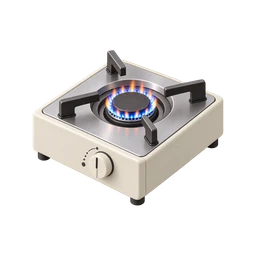
Did I turn off the gas?
Updated November 3, 2026
Gas is the one people lose sleep over. Maybe it's the stovetop after a late dinner, the gas fireplace, or the shut-off valve on a camping stove or barbecue. The worry is sharper than with an electric appliance, and for good reason.
First, the part that matters most: if you can smell gas, stop reading and leave the building. Everything else on this page is for the far more common situation, where nothing seems wrong but you can't remember turning the knob.
Why you can’t remember
Turning a gas knob to off is a small, fast motion. On many stoves you push in and twist, the flame disappears and you're done. Because the flame goes out instantly, there's nothing to watch afterward, and the action slides into the same blurry category as locking a door or flipping a light switch.
Gas knobs can also be hard to read. On some ranges, the off position is only a few degrees from the lowest flame, and on a sunny day a small blue flame is nearly invisible. Fireplaces and grills often have separate valves and pilot lights, which adds more steps you might not remember doing. When you try to picture it later, the image doesn't have that fine detail.
Repetition blurs the rest. Each night's knob-turn looks like the last, so the memory you pull up may not be from tonight. And because the stakes feel high, people often check gas appliances several times. That backfires: studies on repeated checking show memory confidence drops the more you check, which can leave you more anxious than before you started.
How to check right now
- If you smell gas, leave
Don't touch switches, appliances or your phone inside. Get everyone out, leave the door open if it's easy, and call your gas company or emergency number once you're outside.
- Ask someone home to look at every knob
They should look straight at each knob and confirm it's in the off position. A low flame can be hard to see, so the lack of one proves little.
- Think about which appliances you used
Stove, oven, fireplace, grill? Narrow the worry to the ones you used today. If you didn't use the grill, you don't need to worry about its valve.
- Go back if nobody can check
With gas, guessing isn't worth it. If you can't confirm another way, return once and check calmly.
Safety note. If you smell gas (often a rotten-egg smell), leave the building immediately. Don't switch lights or appliances on or off, don't light anything, and don't use your phone inside. Call your gas company or emergency services from outside. Fit a carbon monoxide alarm in any home with gas appliances and test it regularly.
How to stop rechecking
- Look at each knob straight on
Before you leave the kitchen, face the stove and check each knob individually. Lining up your eyes with the marker makes "off" unambiguous.
- Say "gas off" with the day
"Gas off, Friday night." The spoken words and the day give your memory a specific tag that's easy to pull up later.
- Close outdoor valves the same way every time
For barbecues and camping stoves, close the tank or cylinder valve as the final step after the burners, every time. A fixed order means finishing the sequence tells you the valve is closed.
- Install a gas or carbon monoxide detector
Detectors don't replace turning the gas off, but they add a warning if something goes wrong. Many fire services recommend CO alarms in any home with gas appliances.
- Photograph the knobs
A quick One Loop camera confirmation of the knobs at off gives you a timestamped photo you can open later. It doesn't detect gas; it shows you checked.
Questions people ask
What should I do if I think I left the gas on?
If you smell gas, leave and call your gas company from outside. If you don't smell anything but aren't sure, have someone check that every knob is at off, or go back and check yourself.
How long can a gas stove be left on?
A gas burner shouldn't be left on unattended at all. If a flame blows out while the gas is still flowing, gas can build up indoors, which is dangerous.
How do I know if my gas stove is off?
Look directly at each knob and make sure it's at the off marker. Don't rely only on seeing no flame, because low flames can be hard to see in bright light.
Will a carbon monoxide detector detect a gas leak?
Not usually. CO detectors sense carbon monoxide, not natural gas itself. Separate natural gas detectors exist, and some combination units do both.
Other things people double-check
Checklists that include this


Confirm it once. Stop wondering.
One Loop keeps a timestamped tap, voice note or photo of the things you do on autopilot. Free to try for 7 days.
Download on the App Store